

sales qualification agent
timeline-based lead routing
project overview
Context: Sellers spend over 20 hours a week chasing unqualified leads.
Objective: Help sellers qualify prospects more efficiently through BANT criteria, particularly timeline-based routing that schedules near-term prospects for meetings while gathering details from longer-term prospects for follow-up.
Role: Conversation Designer
Duration: 3 months
Methods: User interviews, Flow Charts, Prompt Engineering, Conversation Simulation + Evaluation
From the outset, we knew we wanted to cut down on the time it takes SaaS sales representatives to qualify leads through a conversational experience.
I asked:
How do you qualify a lead through conversation?
What takes the most time?
challenge
research
I interviewed sales development representatives and account executives, two key groups involved in qualifying prospects. Sales representatives sit at the top of the sales funnel, gauging initial interest and booking meetings. Account executives delve deeper into prospects’ business challenges, budget, timeline, and authority to make decisions (BANT).
Key findings:
Business need and product fit are strong early signals for buying potential.
Account executives prioritize intent-to-purchase timelines to maximize their time.
Near- or mid-term leads are prioritized; longer-timeline leads are nurtured later.
Sales qualification involves weighing complex factors like budget realism so the agent needs to gather information early for account executives, not replace human judgment.
Survey data from our research team validated that buyers were excited about conversational AI answering product questions and routing them to best-fit sellers.
design
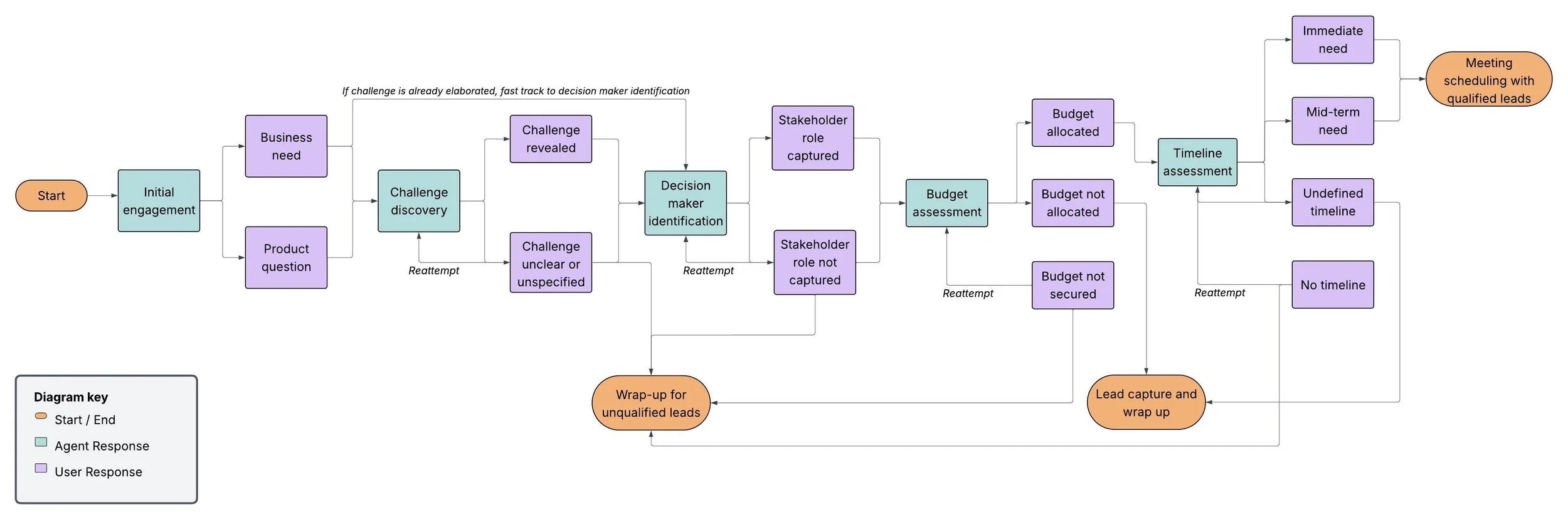
At this point, I had a strong understanding of how a conversational UI could support an existing human workflow—using buyer timelines as routing criteria. Prospects expressing near- or mid-term timelines (3-6 months) are routed to meeting scheduling. Longer-timeline prospects receive information and future follow up. At any point, prospects can be routed to wrap-up if they evade questions or aren’t serious.
Initially, the team wanted to phase the conversation (Product Q&A first, then qualification). I recommended interweaving qualification questions into the conversation naturally so buyers see value rather than feeling interrogated. Through artifacts defining our ideal experience, the team aligned on the more intuitive approach.
limitations
Sensitive information: Agent doesn’t ask about budget directly; instead asks about budget status (whether budget is allocated) so sellers have some indication before scheduling calls.
Platform constraints: Agent follows set order of questions (need → authority → budget status → timeline) instead of adapting completely to conversation flow. We plan to improve this in future iterations.
conversation simulation & iteration
Simulating scenarios (user has question vs. user expresses direct need) allowed me to iterate on prompts based on evaluation results.
Initially, the agent over-indexed on RAG data, providing verbose product answers. I refined the interaction pattern so that the agent:
1. Shows value through relevant, non-intrusive questions connected to buyer goals.
2. Gives a preview and gets buyers excited without going too deep—that’s the human seller’s job.
outcome
The product hasn’t launched yet, but early UAT results suggest both sellers and buyers see value in this experience. Timeline-based routing allows sellers to prioritize near-term prospects while capturing information for nurturing longer-term leads.